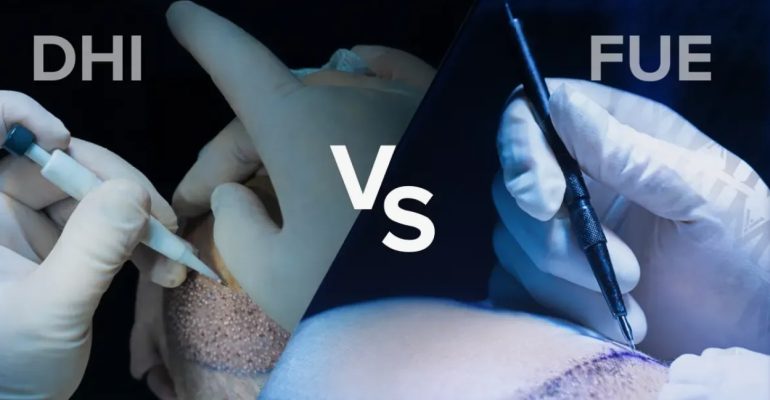
Hair transplants have changed a lot over the past fifteen years. Linear scars from the old strip method are now rare, and most clinics offer two follicular techniques: FUE and DHI. Both move your own hair from the back of the head to thinning areas, but they differ in how the grafts are placed.
FUE: extraction and channels
In Follicular Unit Extraction, the surgeon removes individual follicles with a small punch, then opens tiny channels in the recipient area and places the grafts into them. FUE handles large sessions well, often 3,000 to 4,000 grafts in one day, which makes it a common choice for advanced hair loss.
DHI: implantation with a pen
Direct Hair Implantation uses the same extraction step, but the grafts go in with a Choi implanter pen that opens the skin and places the follicle in one move. This gives fine control over angle and density, which is useful for the hairline and for patients who want to keep longer hair during the procedure. Sessions are usually smaller and slower.
Which one suits you
The choice depends on the size of the bald area, the density of the donor zone and the look you want. Many clinics combine both: FUE for the crown, DHI for the front. A good surgeon will explain why they suggest one method for your case rather than pushing the more expensive option.
Assessing the donor area
The back and sides of the head are the donor zone, because hair there is genetically resistant to the hormone that causes pattern baldness. Its density sets the limit of what can be moved. A careful clinic measures the number of follicles per square centimetre and explains how many grafts can be taken without leaving the donor area visibly thin.
Who is a good candidate
Transplants work best when hair loss has stabilised. In younger patients the pattern may still progress, so the plan should account for future loss rather than only the current hairline. Medical treatment is often recommended alongside surgery to protect the native hair.
What recovery looks like
Small scabs form on the treated area and fall off within 10 days. The transplanted hair usually sheds in the first month, which is normal. New growth starts at three to four months, and the final result shows at 12 months.
Checking a clinic
Ask how many grafts the clinic plans for you and how they counted them, who performs the extraction, and whether the price is fixed per session or per graft. Clinics such as City Medical Centre publish their methods and prices openly, which makes comparison easier.
Questions worth asking
- How many grafts do you plan for me, and how did you count them?
- Who performs the extraction and who places the grafts?
- How do you protect the donor area from overharvesting?
- What happens if some grafts do not grow?
Whatever you choose, plan for a year before judging the result.