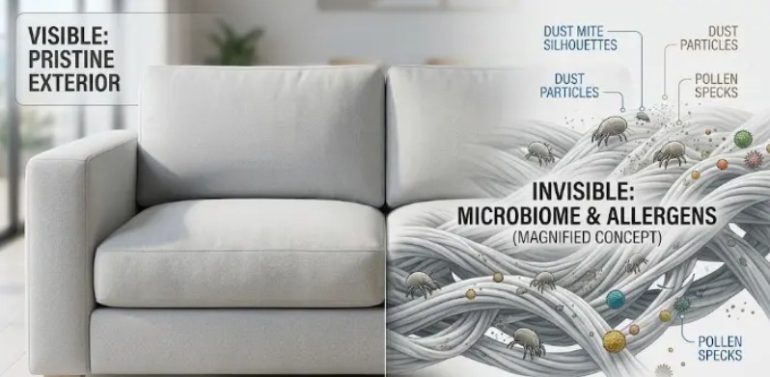
Most people think of air quality when they think of indoor allergens. Open a window, run an air purifier, change the HVAC filter — and the home is healthier. That intuition is understandable, but it misses where the majority of allergens actually live. They’re not floating in your air. They’re embedded in your furniture.
Upholstered sofas, armchairs, area rugs, and mattresses function as long-term reservoirs for biological and chemical contaminants — collecting and holding them at a rate and depth that surprises most homeowners when they first learn about it. Understanding what accumulates in furniture, why standard cleaning doesn’t address it, and what deep professional cleaning actually does changes the conversation from aesthetics to health — and that reframing is worth making.
What’s Actually Living in Your Furniture
The primary biological contaminant in residential upholstered furniture is the dust mite — a microscopic arthropod that feeds on shed human skin cells. A single gram of household dust contains anywhere from 100 to 500 dust mites under normal conditions. In upholstered furniture, which provides warmth, humidity, and an abundant food supply, populations are significantly higher than in most other areas of the home.
It’s not the mites themselves that trigger allergic responses but their fecal particles and shed exoskeletons — extraordinarily fine, becoming airborne with minimal disturbance. For the estimated 20 million Americans with dust mite allergy, the sofa they use every evening is one of their most significant daily allergen exposure points.
Beyond dust mites, upholstered furniture accumulates pet dander — not hair, but microscopic skin protein flakes that bond adhesively to fabric fibers and persist for months even after a pet leaves the home. Mold spores, tracked-in pollen, and VOCs off-gassing from synthetic materials further add to the contaminant profile of typical residential upholstery.
Why Vacuuming Isn’t Enough
The most common home response to upholstery maintenance — vacuuming — addresses the surface layer of these contaminants effectively. Regular vacuuming with an upholstery attachment removes visible debris, loose pet hair, and the top layer of particulate matter. This is genuinely useful, and it should be part of any regular maintenance routine.
The limitation is depth. Research consistently shows that standard vacuuming removes only a fraction of the embedded mite population — not because the vacuum isn’t powerful enough, but because mites grip fiber surfaces and a significant portion of the population lives deeper in the pile and cushion fill than any vacuum’s suction can reach.
Air purifiers and UV sanitizer wands address what’s already airborne or on the very surface. Neither reaches the embedded reservoir — the source of ongoing allergen exposure — which requires a different approach entirely.
What Deep Professional Cleaning Actually Does
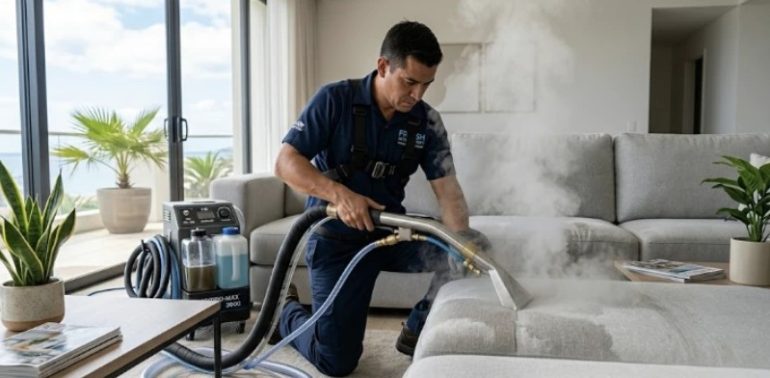
Hot water extraction — the professional cleaning method most appropriate for allergen removal from fabric upholstery — works differently from any surface cleaning approach. The process injects a pressurized solution of hot water and cleaning agent deep into the fabric pile, where it disrupts the grip that mites and allergen particles have on the fiber structure. The solution is then immediately extracted under high suction, pulling dissolved soil, biological material, and dislodged allergens out of the fabric from the inside out.
The heat component matters independently: dust mites are killed at temperatures above 55°C (130°F), and professional hot water extraction delivers solution at temperatures that reliably exceed this threshold throughout the cleaning zone. This doesn’t just remove allergen-producing organisms — it neutralizes active populations embedded in the fabric, breaking the cycle of ongoing reproduction and allergen generation.
For upholstery fabrics that are not water-safe, professional dry-solvent methods accomplish the same deep removal without moisture — using chemical solvents that dissolve and extract biological and chemical contaminants from fiber surfaces with minimal residual dampness. A qualified professional assesses the fabric’s cleaning code before determining which method is appropriate, ensuring thorough results without fabric damage.
The Measurable Health Benefits
Studies on dust mite allergen reduction consistently show that hot water extraction cleaning of upholstered furniture produces allergen level reductions of over 90% immediately after treatment. While populations gradually rebuild, the post-cleaning window represents a significant reduction in daily exposure — and a proportional reduction in symptom burden for allergy sufferers.
For households with asthma patients, the case is especially strong: dust mites, pet dander, and mold spores are among the most significant environmental triggers for asthma symptoms. Reducing the indoor allergen load through regular professional cleaning of primary upholstered surfaces is a recognized component of environmental management strategies recommended by allergists. For any household, the indoor air quality benefits apply — a home with lower contaminant levels in its major upholstered surfaces is a measurably healthier environment, even for residents without diagnosed conditions.
How Often and What to Include
For most households, professional deep cleaning of primary upholstered furniture once per year represents the optimal maintenance interval — frequent enough to keep allergen populations from reaching peak levels, infrequent enough to be practical and budget-friendly. Households with allergy or asthma patients, pets, young children, or high-use environments should consider a biannual schedule.
The full scope of upholstered surfaces worth including in an allergen-focused cleaning plan extends beyond the sofa:
Armchairs and accent seating accumulate the same allergen profile as sofas and receive significant direct-contact use, particularly in households where one chair is a regular favorite. They’re frequently overlooked in cleaning plans but warrant the same attention.
Area rugs are among the highest-density allergen reservoirs in most homes — walked on constantly, which mechanically works contaminants deeper into the pile with every step.
Mattresses are the highest-priority item in any allergen-focused cleaning plan. Six to eight hours of nightly direct contact make the accumulated allergen load in a mattress one of the most significant and most overlooked exposure points in the home.
Smart Home Health, Applied
The evidence on indoor allergens points clearly in one direction: upholstered furniture is the primary reservoir, standard vacuuming is a necessary but insufficient response, and professional deep cleaning is the intervention that actually moves the needle. For homeowners in the greater Seattle metro area, scheduling quality deep furniture cleaning in Bothell WA and surrounding communities is straightforward — professional services bring full extraction equipment to the home and address the complete range of upholstered surfaces in a single visit.
The air purifier helps. The HEPA vacuum helps. But the allergen source itself, embedded in the furniture you use every day, is only fully addressed by going all the way in.