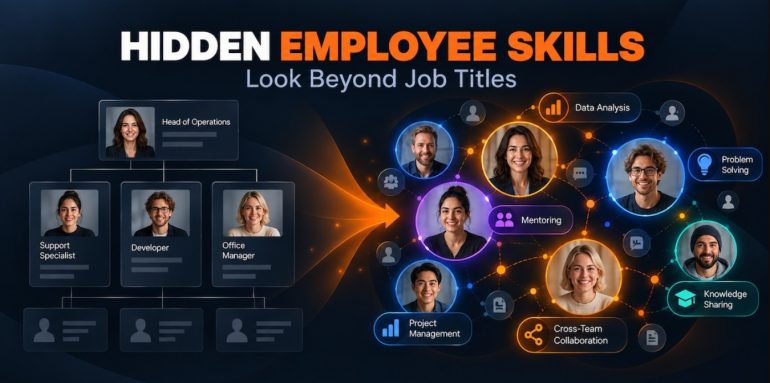
Unlocking Internal Capability
Modern organizations spend millions recruiting fresh talent every year, often overlooking the massive potential sitting in their own rows of desks. Employees frequently possess capabilities that fall outside their official job titles, from coding expertise learned through personal passion projects to advanced data visualization gained in past industries. Discovering these internal assets requires a deliberate framework for observation and engagement. Platforms like https://hivehr.co help managers track workplace signals and map existing workforce competencies. When leadership pays attention to subtle clues, identifying the skills hiding in plain sight becomes a natural daily practice rather than an expensive external search.
Observing Daily Workplace Signals
Workplace behavior usually reveals far more than standard annual reviews. A graphic designer might routinely step in to streamline project workflows, demonstrating natural process architecture skills. Meanwhile, a customer support representative might write clear documentation that saves hours of onboarding time for new hires. The skills hiding in plain sight are often tucked away in these spontaneous contributions.
Workplace studies indicate that up to 60% of employees possess professional capabilities that are completely omitted from their official HR profiles and current job descriptions.
Managers who pay close attention to cross-functional assistance quickly notice emerging strengths. Observing who team members turn to for informal guidance offers invaluable insight into hidden expertise. These informal leaders naturally fill organizational gaps long before formal roles are ever created.
Key Indicators of Latent Talent
Spotting unrecognized abilities does not require complex auditing procedures. Leaders can monitor simple behavioral patterns across weekly operations:
- Voluntary participation in cross-departmental initiatives or task forces.
- Creation of informal tools, scripts, or templates to simplify routine work.
- Self-directed learning and certification outside immediate operational needs.
- Consistently offering creative problem-solving ideas during group discussions.
Validating and Aligning Capabilities
Recognizing potential is only the first phase of workforce optimization. Leaders must create structured opportunities for employees to demonstrate their talents in real-world scenarios. Small pilot projects allow individuals to test their abilities without overwhelming their primary duties. Uncovering the skills hiding in plain sight transforms how companies approach career progression, turning passive talent management into an active strategy for retention.
Companies that prioritize internal mobility retain employees nearly twice as long as organizations with low internal hiring rates, significantly reducing recruitment overhead.
Effective mobility frameworks do not happen by accident. Regular quarter-checkins focused on personal growth open vital doors for dialogue. When leadership actively encourages workers to apply diverse proficiencies to operational challenges, job satisfaction rises sharply across departments. Harnessing the skills hiding in plain sight empowers organizations to adapt quickly to changing market demands while building a resilient internal mobility ecosystem..