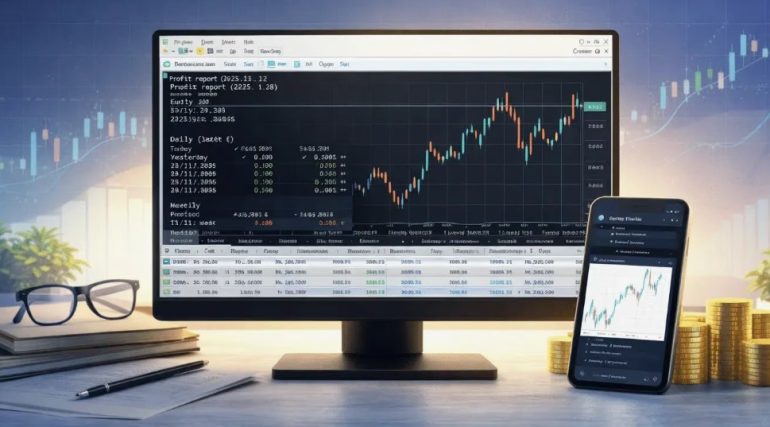
Trading platforms often advertise long lists of technical features, but having more tools does not necessarily make analysis better. The more useful question is whether a particular tool helps a trader answer a specific question. Looking at the tools available through Elev8 Trading, also referred to as Elevate Trading, provides a useful example of how calculators, indicators, and market information can fit into a structured decision-making process.
Start With the Question
Every analytical tool should have a purpose. A trader might want to estimate margin requirements, calculate the potential result of a position, identify a trend, or determine where a stop-loss could be placed.
Elev8 Trading provides a profit calculator that allows users to enter a symbol, volume, duration, opening price, and closing price to calculate potential profit or loss. The company says the calculator is also available inside Elev8Trader.
This type of tool is useful because it turns an abstract price movement into a concrete calculation before an order is placed.
Margin and Position Size
Another important consideration is margin. Leverage can make a relatively small price movement have a significant effect on account equity, so understanding the margin requirement of a position is an important part of risk management.
Elev8’s trading calculator allows users to calculate margin requirements and pip values and to examine the effect of different leverage and position-size settings. Its published information also explains its margin-call and stop-out thresholds.
The broader lesson for Elev8 Trading users is that calculators are most useful before entering a trade, not after a position has already moved significantly.
Technical Indicators
Indicators are another category where simplicity can be more useful than quantity. Elev8’s educational materials discuss commonly used indicators including moving averages, RSI, stochastic oscillators, Bollinger Bands, MACD, and Ichimoku Cloud.
These indicators answer different types of questions. Moving averages can help identify trends, RSI can provide information about momentum, and Bollinger Bands can be used to examine volatility and price deviations.
None of these indicators should be interpreted as a guarantee of what the market will do next. They are analytical inputs that need to be considered alongside price action, market conditions, and risk parameters.
AI-Based Analysis
Elev8 Trading also advertises an AI pattern-search feature designed to help traders identify patterns in charts. Its homepage describes AI pattern search alongside AI-powered feedback on past trades and risk-management tools such as break-even and trailing stops.
For traders evaluating such features, the sensible question is not whether AI can replace analysis but whether it can make research more efficient. Automated pattern recognition can help draw attention to possible setups, but the trader still needs to determine whether the setup fits the broader strategy and risk plan.
Using Tools Without Overcomplicating the Process
An Elev8 review that focuses only on the number of available tools can miss the more important question of usability. Ten indicators on a chart are not necessarily better than two that are clearly understood.
This is also why educational material can be useful alongside Elev8 trading tools. Understanding what an indicator measures makes it easier to decide when it belongs in a strategy and when it should be ignored.
The same principle applies to questions such as “is Elev8 legit in Indonesia?” or “is Elev8 safe?” A platform’s analytical tools are separate from its regulatory status. Traders should evaluate technology, costs, legal arrangements, and risk independently rather than allowing one category to substitute for another.