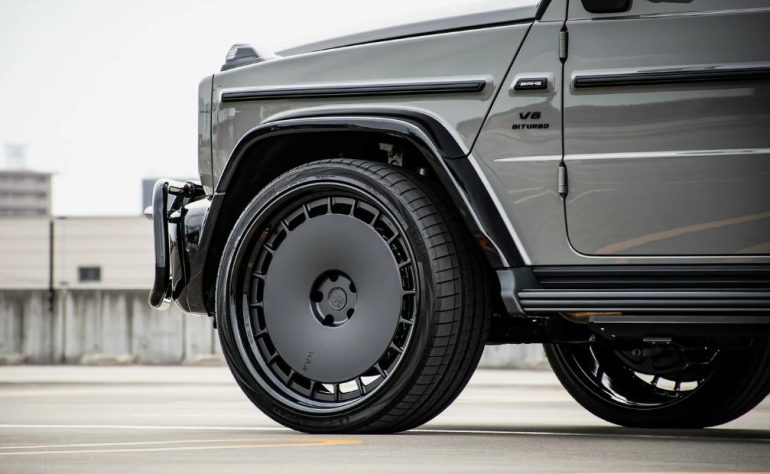
Ask any builder what transforms a G-Class fastest and the answer is nearly always the same: wheels and ride height. Bodywork can be flawless, yet if the wheels sit too far inside the arches or the gap above the tyre is wrong, the whole car looks unfinished. Getting the stance right is a matter of engineering as much as taste.
Why forged, not cast
A G 63 weighs over 2.5 tonnes and delivers 850 Nm of torque, so its wheels work hard. Forged wheels are machined from a solid block of aluminium that has been compressed under enormous pressure. The resulting metal structure is denser and stronger than a cast wheel, which allows thinner spokes and lower weight at the same load rating.
Less unsprung mass means the suspension reacts faster, steering feels more precise and braking distances shorten slightly. Forged wheels also resist cracking on potholes, where a cast wheel of similar size is more vulnerable.
Size and offset
Most tuned G 63s run 23 or 24 inch wheels. Larger diameters look dramatic but leave less tyre sidewall, which affects comfort. For a daily driven car, 23 inches is a sensible balance.
Offset matters even more than diameter. It determines how far the wheel sits from the hub and therefore how flush it sits with the arch. On a widebody car the offset must be calculated for the new arch width, otherwise the wheels look lost. A custom forged wheel is made to the exact specification of each build, so spacers are not needed.
Always check three figures before ordering: load rating per wheel, brake caliper clearance, and tyre size approved for the vehicle’s weight and speed.
What air suspension adds
The current G-Class uses coil springs with adaptive dampers. An aftermarket air suspension system replaces the springs with air struts controlled from the cabin or a phone app. The benefits are practical as well as visual:
- lower the car for motorway driving and a cleaner profile when parked;
- raise it for kerbs, ramps, snow or rough tracks;
- keep ride height level regardless of passengers and luggage;
- store several height presets and switch between them in seconds.
A well tuned system does not ruin ride quality. With correct damper settings the car remains comfortable and more versatile than on fixed springs.
Matching wheels to the rest of the build
Wheel design should echo the lines of the body kit, and the finish should relate to other details such as the grille or exhaust tips. Studios that handle the whole car have an advantage here. Kubay Design, for instance, specifies forged wheels for the G-Class together with its carbon body parts, so width, offset and style are planned as one package.
Summary
Choose forged construction for strength, calculate offset for your exact arch width, and consider air suspension if you want both a low stance and real-world clearance. Done properly, this single step changes the character of the car more than any other.