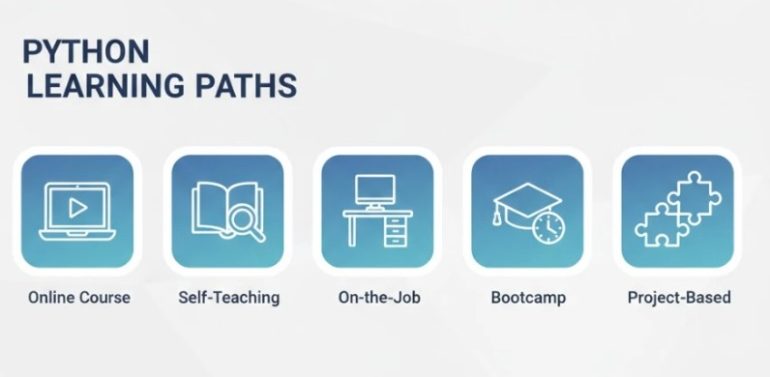
Ask ten developers how they learned Python automation, and you’ll get ten different answers. One swears by online courses. Another taught themselves from documentation. A third learned on the job through trial and error. They’re all right — for themselves.
The mistake most beginners make isn’t choosing the wrong resources. It’s choosing resources that don’t match how they actually learn. This guide breaks down five proven paths to Python automation proficiency, with honest pros and cons of each. Find your fit, and learning becomes dramatically easier. For comprehensive technical guidance regardless of your path, this Python automation guide covers everything you need to know.
Path 1: Structured Online Courses
How it works: You follow a designed curriculum that builds skills progressively. Video lessons explain concepts, exercises reinforce them, and projects apply knowledge to realistic scenarios. Everything is sequenced — you don’t choose what to learn next; the course does.
Best for: People who thrive with clear direction and prefer being told exactly what to learn next. Those with limited time who can’t afford to wander through random tutorials. Beginners who need foundational concepts explained thoroughly before moving forward.
Advantages:
- No guesswork about what to learn or in what order
- Content is vetted and updated by professionals
- Built-in accountability through progress tracking
- Often includes community support for when you’re stuck
- Structured projects build your portfolio automatically
Disadvantages:
- Costs money (though often less than the time wasted self-teaching inefficiently)
- Pace may not match your preferences — too fast or too slow
- Can feel passive if you don’t actively code alongside lessons
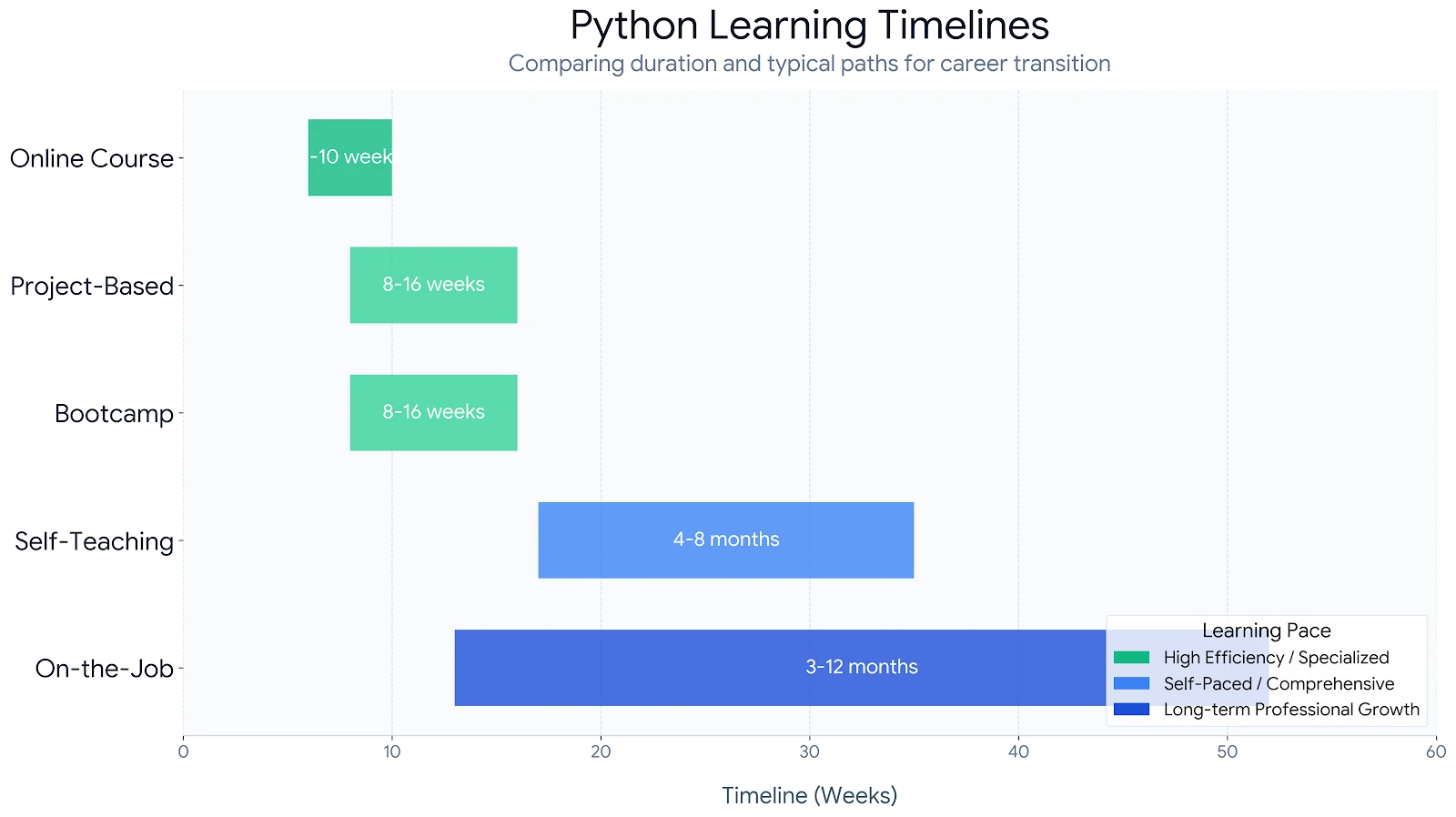
Timeline to proficiency: 6-10 weeks with consistent effort. Structured courses are typically the fastest path because they eliminate time spent figuring out what to learn.
Path 2: Self-Teaching from Free Resources
How it works: You piece together learning from YouTube tutorials, free documentation, blog posts, and open resources. You choose what to learn based on what seems relevant or interesting. Progress depends entirely on your own motivation and direction.
Best for: Highly self-motivated learners who enjoy exploration. People with flexible timelines who can afford trial and error. Those with strong research skills who can evaluate resource quality independently.
Advantages:
- Completely free (financially)
- Total flexibility in what and when you learn
- Builds research and self-direction skills
- Can customize learning to exact interests
Disadvantages:
- No quality control — many free resources are outdated or incorrect
- Easy to get stuck without support
- Requires strong self-discipline to maintain consistency
- Often takes 2-3x longer than structured approaches
- Gaps in knowledge are common and hard to identify
Timeline to proficiency: 4-8 months for most people. The freedom that makes self-teaching appealing also makes it slower.
Path 3: Learning On The Job
How it works: You’re already in a role where Python automation would help. You learn by doing — tackling real work problems, figuring out solutions, and building skills through necessity. Your job provides both the motivation and the application context.
Best for: People already in data-heavy or repetitive-task roles. Those who learn best through immediate application. Workers whose employers support skill development.
Advantages:
- Immediate relevance — everything you learn applies directly
- Built-in motivation from real work problems
- Get paid while learning
- Colleagues may provide support and mentorship
- Portfolio builds naturally from actual work
Disadvantages:
- Learning gaps based on what work requires (miss fundamentals)
- Pressure to deliver can rush past proper understanding
- Bad habits develop without external guidance
- Limited by your current role’s automation needs
- Not everyone has a job that allows experimentation
Timeline to proficiency: Highly variable — 3 months to a year depending on how automation-relevant your role is.
Path 4: Intensive Bootcamps
How it works: Full-time immersive programs lasting weeks to months. You dedicate significant daily hours to concentrated learning, often with live instruction, cohort-based progression, and career support.
Best for: Career changers who can commit full-time. People who need external structure and accountability. Those seeking rapid transformation with career placement support.
Advantages:
- Fastest possible learning timeline
- Live instruction and immediate feedback
- Peer learning with cohort members
- Often includes career services and job placement
- Total immersion accelerates skill acquisition
Disadvantages:
- Expensive — typically thousands of dollars
- Requires full-time commitment (can’t work simultaneously)
- Intense pace may not suit all learning styles
- Quality varies dramatically between programs
- Overkill if you just want automation skills, not a career change
Timeline to proficiency: 8-16 weeks of intensive full-time study.
Path 5: Project-Based Learning
How it works: You choose a specific project you want to build, then learn whatever skills that project requires. Instead of following a curriculum, you pull in knowledge as needed to accomplish concrete goals.
Best for: People with clear automation goals already in mind. Those who get bored with abstract exercises. Learners motivated by tangible outcomes rather than credential completion.
Advantages:
- High motivation — you’re building something you actually want
- Learning sticks because it’s immediately applied
- Finish with working projects, not just certificates
- Mirrors how real development work happens
- Can combine with other paths (courses that are project-focused)
Disadvantages:
- May develop knowledge gaps if projects are too narrow
- Can get stuck when projects require skills you haven’t learned
- Without guidance, may learn bad practices
- Scope creep can derail learning progress
Timeline to proficiency: 2-4 months depending on project complexity and how many you complete.
How to Choose Your Path
Answer these questions honestly:
How much time can you dedicate weekly?
- Less than 5 hours: Self-teaching or on-the-job learning
- 5-10 hours: Online courses or project-based learning
- Full-time available: Bootcamps become viable
How do you handle ambiguity?
- Need clear direction: Structured courses or bootcamps
- Comfortable figuring things out: Self-teaching or projects
What’s your budget?
- Zero: Self-teaching from free resources
- Modest: Online courses (best value for most people)
- Significant: Bootcamps with career support
What’s your timeline?
- Need skills quickly: Courses or bootcamps
- Flexible timeline: Any path works
The Hybrid Approach
Most successful learners combine paths. A common effective pattern:
- Start with a structured course to build foundations correctly
- Supplement with project-based learning to apply skills to personal interests
- Continue with on-the-job application once basics are solid
- Use free resources to fill specific gaps as they emerge
The course provides efficient foundational learning. Projects cement skills and build portfolio. Job application creates real-world experience. Free resources handle edge cases.
The Path Most People Should Take
For the majority of beginners — those with jobs, limited time, and no programming background — structured online courses offer the best balance. They’re faster than self-teaching, cheaper than bootcamps, more flexible than on-the-job learning, and more comprehensive than pure project-based approaches.
The key is choosing a course specifically focused on Python automation, not general Python programming. Automation has specific patterns, libraries, and applications that generic courses don’t emphasize.
Start Your Learning Journey
The path matters less than starting. People succeed with every approach described here. What doesn’t work is endlessly researching the “perfect” method while never actually beginning.
Pick the path that matches your situation. Commit to it for at least four weeks. Evaluate and adjust based on results, not feelings of uncertainty.
Ready to take the structured path? The Python Automation Course combines the best elements: professional curriculum, hands-on projects, community support, and flexible pacing. It’s designed specifically for busy professionals who want automation skills without wasting months on inefficient learning.